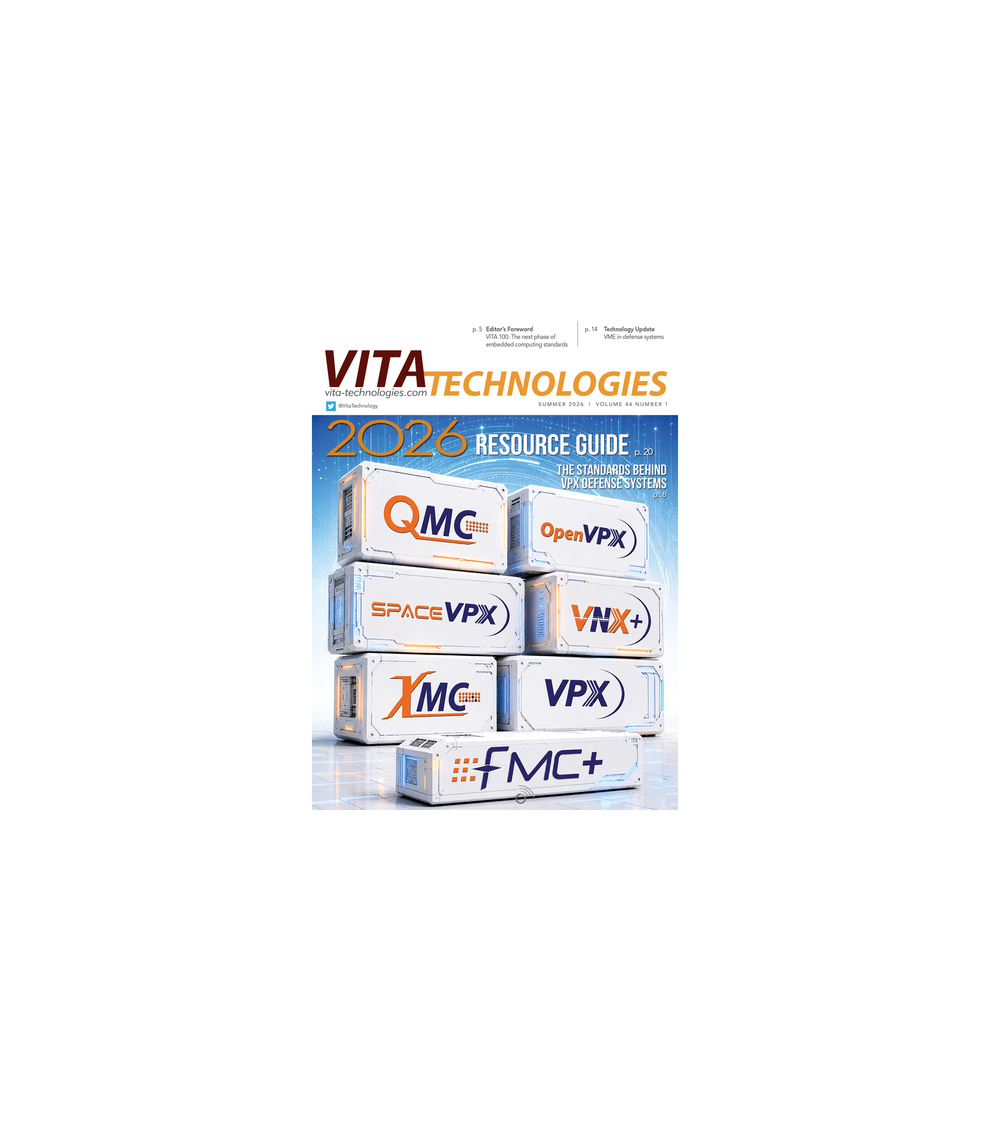
OpenVPX takes the best parts of VPX – namely the vast number of available I/O pins and high-speed serial fabrics – while limiting permutations to various system profiles. Also, incorporating the equivalent of control, data, and management planes improves system maintainability while forcing vendors to stick to preconfigured I/O routing. Together, these constraints enable interoperability between vendors within the same backplane. Boards and modules fit together in predictable ways, much like the toy building blocks shown on the cover of this Special Supplement on OpenVPX with Executive Speakouts. But OpenVPX systems are not toys; they’ll soon form the basis of next-gen high-rel systems with ample features and headroom for decades to come.
But how did OpenVPX come into existence? Where will it go next? VME and Critical Systems magazine has extensively documented the genesis of OpenVPX this year, from an idea hatched inside of Mercury Computer Systems, all the way to the eventual “marriage” between the 28 OpenVPX Industry Working Group companies and VITA. The Working Group symbolically passed a mostly ready-to-go OpenVPX spec to VITA on October 19 during a press conference at MILCOM. Upon receipt, the spec became known as VITA 65. The VITA 65 committee soon conducted the first ballot to ready the spec for ANSI approval. Sent out on November 3 and closed on November 17, this “Revision 1.0” specification didn’t obtain the necessary 66 percent for ANSI submission1 and the committee is addressing the feedback while readying the spec for another ballot by January 5, 2010.
“Revision 1.0” of OpenVPX was 382 pages long containing myriad technical details of how to map signals and planes to assure vendor interoperability. According to Pete Jha of Curtiss-Wright Controls Embedded Computing (CWCEC), senior software engineer and chair of the VITA 65 committee, there were “lots of editorial changes to incorporate, ranging from errors because of our fast-track [OpenVPX Industry Working Group] effort, oversight errors, and modifications and clarifications.” The spec had grown to 405 pages at the time of our interview. But most importantly, there were no “show-stoppers from a technical standpoint,” and a new revision began circling for ballot on December 8. Both CWCEC’s Jha and Mercury Computer have a high confidence that ballot number two will succeed. This means it should be submitted for ANSI approval by the end of January, making it an official worldwide open-standard specification.
The “open standard” part is the root of the whole effort, stating that any company can build OpenVPX products (boards, backplanes, chassis, and systems) while guaranteeing that if the spec is followed, bits from different vendors will play together. VITA 65 is based upon the VITA 46 (VPX) specification but details how to configure the ecosystem to assure interoperability without being overly prescriptive. Says Mike MacPherson, director of business development for electronic systems and embedded computing at CWCEC, the profiles in VITA 65 tackle “80 percent of the market” such as how to build a Software-Defined Radio system. For instance, VITA 65 neatly defines a profile that interconnects processors located on individual OpenVPX modules.
Once approved by ANSI, future work on OpenVPX will include additional system-level profiles to address some of the “bucket list” items already queuing up. Additionally, specs need to be written that will guarantee interoperability compliance. Says CWCEC’s MacPherson, “We are planning on statements of compliance, verification methods to assure interoperability, and inspection and demonstration analysis techniques.” Additionally, VITA’s VSO is looking at assembling an interoperability lab and holding “plugfests” as is commonly done with networking standards such as Ethernet.
The VITA 65 committee is also working on a “gap analysis” with a five-year or more horizon. One example of a future need is greater-than-5 Gigabit speeds or even fiber-optic connectors. While today’s VXS (VITA 41), VPX, and OpenVPX Tyco MultiGigRT2 connectors have ample speed, 10/100 GbE loom large and would eclipse the Tyco connector. GE Intelligent Platforms is already heading up an effort as part of VITA 46 to investigate future connectors.
So it seems that the ink isn’t even dry on the VITA 65 OpenVPX spec and the vendors are already thinking about making changes. Everyone has high confidence that VITA 65 will become an ANSI spec within a month or so. But there’s even more optimism that OpenVPX represents the legitimate next generation of VME itself – just as long as new features are added while assuring vendor interoperability. After all, the “novelty” of interoperability in an era of custom boards is what made VME one of the most successful embedded open standards of all time. CS
1 VSO ballots can be “approved,” “approved with comments,” or “disapproved.” VITA 65 received the latter.